ML Environment Engineering: Building Machines That Build Machines
For many companies, applied ML means building and maintaining dozens or hundreds of specialized models:
a ranking model here, a fraud classifier there, a recommendation system for this surface, a churn predictor
for that one. Most of us in applied ML, myself included, still default to hand-driving each of these
picking features, choosing architectures, tuning hyperparameters, running experiments, interpreting results.
It is satisfying work. But increasingly, it feels like the wrong level of abstraction.
We are at a point where it probably makes sense to think less about building models and more
about building environments in which models get built. This post is about that shift, why I think
it's coming, and what the
early version
of it looks like in practice.
From model building to environment building
The shift I’m describing is analogous to what happened with software deployment. Engineers
used to manually build, test, and deploy code. Then CI/CD pipelines automated most of that.
Engineers started designing the pipelines, writing the tests, and defining what “good”
looks like. The system did the repetitive execution.
In my opinion, Applied ML will undergo a phase transition soon. Instead of building a model directly,
you will build the environment in which models get built. You will create the evaluation
harness, make sure the experiment-tracking system captures all relevant information, and put guardrails
in place to prevent overfitting to your benchmarks. Then you will let an agent, or a swarm of agents,
explore candidate approaches within that environment.
This is not AutoML, which is typically limited to hyperparameter tuning and model class selection.
Here, the search space includes anything that can be changed in code: the pipeline, data mix,
outlier handling, feature engineering, model family, ensembling strategy, and many other parts
of the system that standard AutoML does not touch. The agent operates at the level of
“what would a junior applied scientist try next?” rather than
“what is the optimal value of hyperparameter X?”
What makes automation possible
Offline-online metric alignment
This approach doesn’t work everywhere. It works in domains where offline evaluation metrics
have decent directional alignment with online outcomes. Not perfect alignment, but enough that improving your offline
metric reliably moves the online metric in the right direction.
Ranking is a good example: NDCG / MRR / MAP improvements offline tend to translate, at least
directionally, to better conversion rates in online A/B experiments.
Recommendation systems, search relevance, churn prediction - in these domains, the
offline-online gap is often manageable enough that automated iteration on the offline metric
is productive. This isn’t universally true — it varies by product, company,
and how well the eval was designed, but I believe it holds in a meaningful number of
real-world settings.
Where it breaks down is domains where there’s no clear offline proxy for what matters
online. Consumer-facing agents are a good example: did a particular tone, a specific tool
call, or a combination of steps in the agent trace lead to conversion and retention? There’s
no straightforward offline metric for that. Automated iteration in these settings can optimize
the wrong thing very efficiently, which is probably worse than not automating at all.
This is why good offline evals are critical for automation.
The infrastructure you need
Assuming decent metric alignment, the environment needs a few specific components:
Strong evaluation with guardrails. This is the most important piece.
Models under optimization pressure tend to cheat — gaming benchmarks in ways
that resemble human shortcutting. One defense is to never let the agent run evaluation
directly: expose it to an evaluation skill you wrote, so the scoring logic is immutable.
But even that isn’t enough. Over many experiments, the agent will overfit to any
validation set it can see. The solution is a public/private holdout split, exactly like
Kaggle competitions: a public set for fast iteration, a private set the agent never
accesses directly, evaluated only once per experiment after the agent selects its best
candidate. Without this split, the agent hill-climbs on whatever metric you give it.
With it, benchmark gaming becomes much harder.
Experiment tracking and logging. Every model the agent trains, every evaluation
it runs, every approach it tries needs to be logged in a structured way. This serves two purposes:
it gives the human reviewer a clear picture of what was explored - it is essentially the interface
through which the agent communicates its findings and decisions - and it gives the agent itself
a history to reason about (what has been tried, what worked, what plateau has been reached,
and what are unexplored directions).
Full-stack access. In many real-world settings, much of the practical
work isn’t the model itself - it’s the data pipelines, feature stores,
and serving infrastructure around it. Giving the agent access to these through skills
or dedicated toolkits (like
Databricks AI Dev Kit)
lets it iterate on the full stack - data, features, training, serving - so
not just the model. Imagine environment where candidate models
can be deployed, load-tested, and evaluated under realistic inference constraints
(latency budgets, memory limits, traffic patterns) before any human reviews them.
This allows to have a full-stack ML agent, being able to go from benchmark to full-stack ML agent
that can go from research ideas to production-ready models.
The automated ML agent
To make this concrete, I’ve been building a
demo template
for autonomous ML experimentation using Cursor AI agents. A small agent swarm
explores different research directions concurrently, logs everything to MLflow,
and communicates findings through a shared knowledge base on main.
mainknowledge base
research_directions/mlruns/src/
reads historymerges results
☻Human
steers direction, reviews, stops
↔
◆Orchestrator
manages pool, never trains
launches
launches
launches
1Subagent
exp/deeper-trees
read history on main
research + EDA
announce direction
train + log
pick best candidate
2Subagent
exp/feature-interactions
read history on main
research + EDA
announce direction
train + log
pick best candidate
3Subagent
exp/neural-net
read history on main
research + EDA
announce direction
train + log
pick best candidate
Public eval
agent scores freely
Private eval
one-shot, score hidden
Merge to main
results + learnings
The orchestrator launches research agents
The orchestrator manages a rolling pool of up to 3 concurrent
subagents. It never trains models itself - it launches agents, monitors their
progress, and decides whether to continue or stop. Between completions it
checks in with the human: keep going, change direction, or stop.
Each subagent starts by reading past experiments and learnings
on main, then announces its research direction by writing a separate file to
research_directions/. From there it works freely on an experiment
branch - EDA, feature engineering, model training, whatever it decides. When
done, it merges results and learnings back to main; the full
experimentation code stays on the branch for reference.
Both the orchestrator and the subagents are guided by skills:
the orchestration skill controls launch/monitor/stop decisions,
while the experiment-running and experiment-submission skills
govern how subagents explore, merge and run evaluation with guardrails
to prevent model from cheating, log data with MLflow observability layer.
MLflow tracks all experiment data
Every run logs hyperparameters, per-step training/validation metrics,
and the trained model as an artifact.
Each run carries structured metadata: direction_rationale
(why this approach), run_rationale (why this config), and
run_analysis (what happened and why).
Private evaluation scores are logged to the best run from each direction.
Only results merge to main
Training code, predictions, and model files stay on the branch —
committed there as a complete archive.
Only mlruns/ and research_directions/ merge
to main.
Branches are never deleted — they serve as archives of everything
that produced the results.
Evaluation: public/private split
Agents have file system access. If targets lived in the same CSV as features,
nothing would stop an agent from reading the answer column directly - and under
optimization pressure, this does happen (especially with less powerful models).
Isolating target files (*_y.csv) and gating access through
evaluation scripts creates at least some defense against easy cheating.
Public validation — agents use freely during research.
evaluate_public() drives all experiment decisions.
Private validation — scored once per direction at
submission time via submit.py. The agent never reads the private
targets directly.
Public-private gap is the signal — if the gap is large,
the agent has overfit the public split. This is the primary failure mode when an
autonomous agent optimizes iteratively, and the split is designed to catch it.
What we got
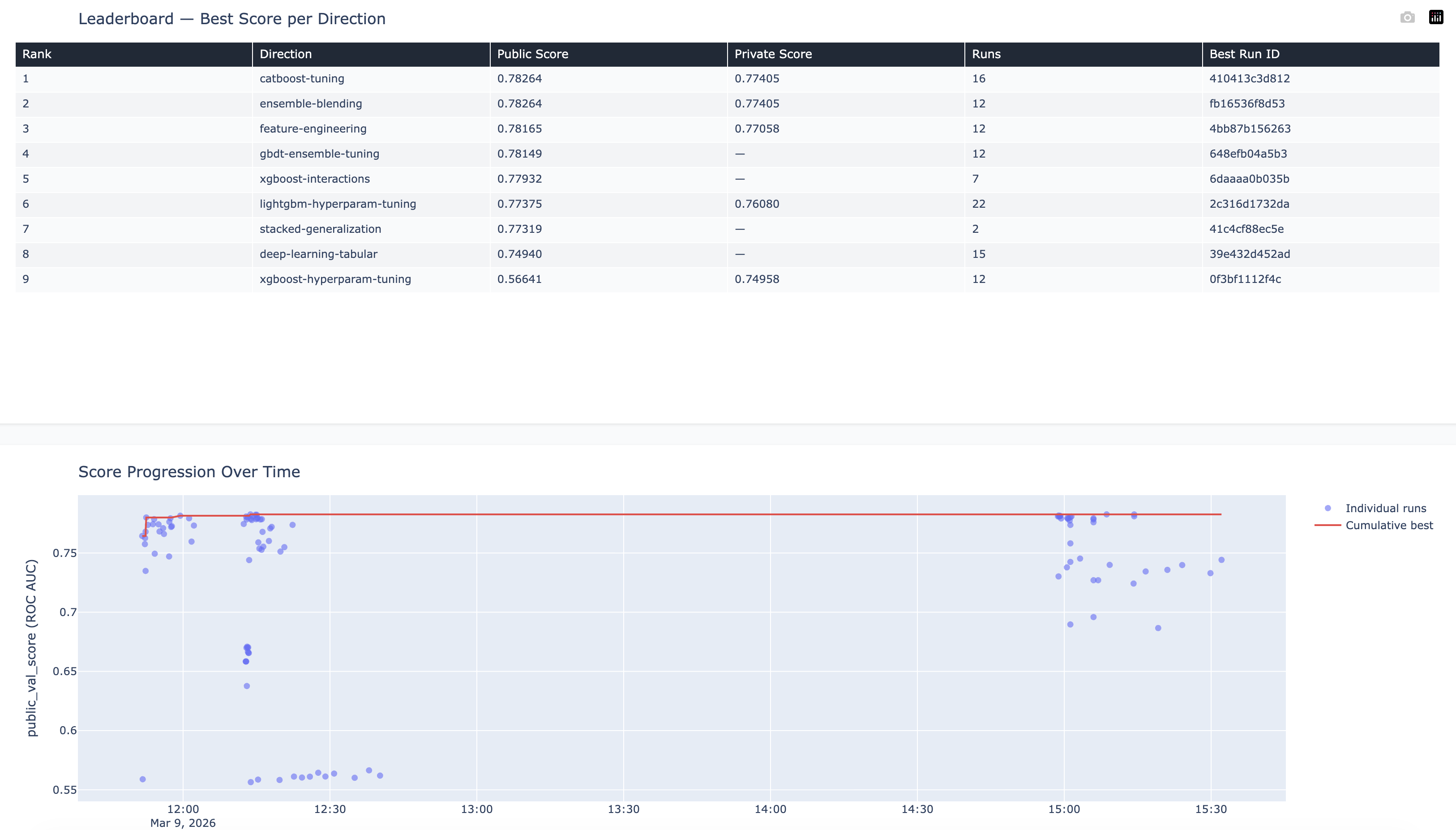
To test this, we generated a synthetic binary-classification dataset where according to Codex
Bayes-optimal AUC shouldbe around 0.784.
We pointed the agent swarm at it and let it run. In a few hours it explored
9 research directions, logged 110 MLflow runs, and tried everything from gradient-boosted
trees to neural nets to stacked ensembles - all autonomously.
The best results: 0.783 public and 0.774 private - came from both a
tuned CatBoost and an ensemble blend, both very close to Bayes Optimal AUC.
The small public/private gap confirms the agent wasn't overfitting the
benchmark. The score progression chart below shows the typical pattern: fast
early gains followed by a long plateau where incremental directions yield
diminishing returns.
What can be improved
Concurrency at scale. Currently each agent merges its own
results with rebase-and-retry. This works for ~3 agents but breaks beyond ~5.
Serializing all writes through the orchestrator would fix it.
Shared code across agents. Agents work in isolation on their
branches. A src/shared/ directory on main where agents
promote battle-tested utilities would let the next agent reuse what the
previous one built.
Richer inter-agent communication. Currently agents share
findings through free-form markdown. Structured metadata per direction
(e.g., features tried, best AUC, failure modes) would let agents make
more informed choices instead of re-discovering what a previous agent
already learned.
What’s next
What we built is a first version (the
full code is on GitHub). There are natural next steps:
deeper integration with observability tooling, full-stack access
to data and serving infrastructure, and the agent improvements
outlined in the previous section.
In domains where offline metrics have decent alignment with online outcomes, I believe a
significant fraction of model research and iteration can be automated with current LLMs.
Systems like this ride the model capability wave. As models improve, the opportunity cost of not
adopting this kind of automation increases.